Affiliate disclosure: This page may contain affiliate links. We may earn a commission when you purchase through them, at no extra cost to you. This does not affect our editorial rating.Learn more.
iPhone 17 Pro vs Samsung Galaxy S26 Ultra
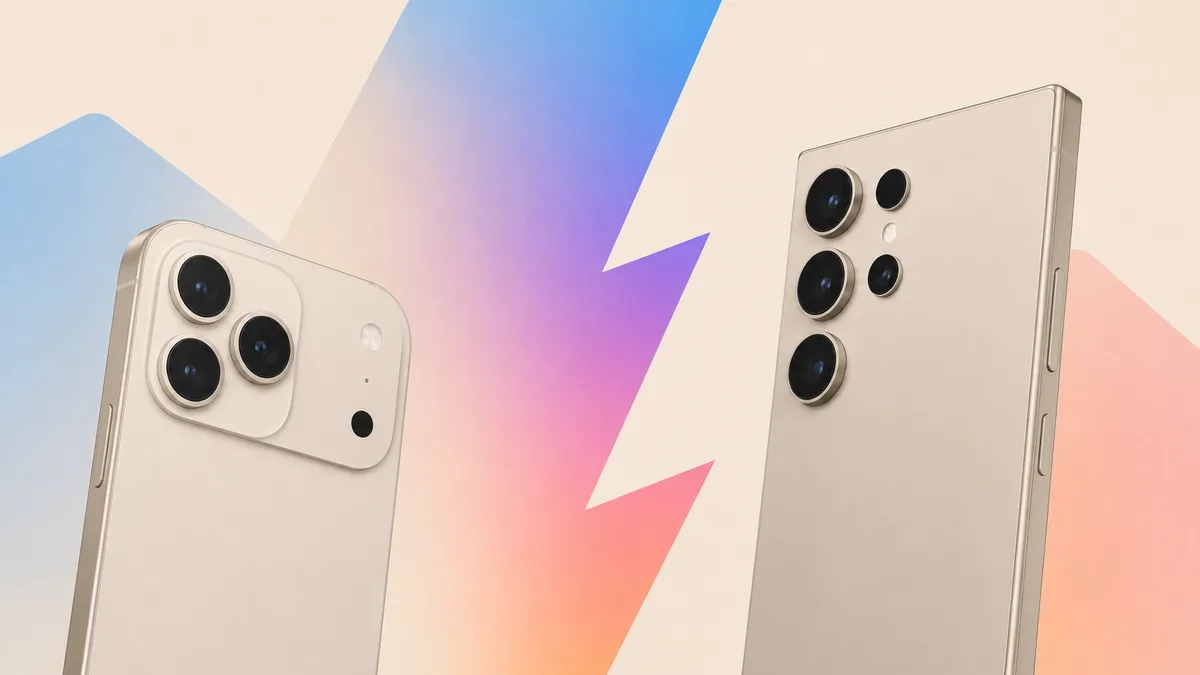
$1,099 · checked Aug 26, 2026
$1,300 · checked Aug 26, 2026
| Feature | iPhone 17 Pro | Samsung Galaxy S26 Ultra |
|---|---|---|
| Starting price | $1,099 (256GB) | $1,299.99 (256GB) |
| Display | 6.3" OLED, 120Hz, 3000 nits outdoor | 6.9" LTPO AMOLED, 120Hz, WQHD+, Privacy Display |
| Chipset | Apple A19 Pro | Snapdragon 8 Elite Gen 5 (3nm) |
| Rear cameras | 48MP x3 (main, ultrawide, 4x tele, 8x optical-quality) | 200MP main + 50MP ultrawide + 50MP periscope (5x) + 10MP tele (3x) |
| Battery | Up to 33h video playback | 5000mAh, 60W wired charging |
| Weight | 206g | 214g |
| Software support | iOS updates, historically 5+ years | 7 major OS upgrades, 7 years security updates |
| Stylus support | Not supported | Built-in S Pen |
Our winner: Tie
There's no clean overall winner here, and pretending otherwise would be dishonest, these are the two best phones either company currently sells, and the "right" pick depends entirely on ecosystem and workflow. Choose the iPhone 17 Pro if you're invested in Apple's ecosystem, want the lighter phone, or don't want to pay the S26 Ultra's $200 premium. Choose the Galaxy S26 Ultra if you want the S Pen, the newer Privacy Display feature, the longer software-support commitment, or simply prefer Android.
Both phones are covered individually in our iPhone 17 Pro review and Galaxy S26 Ultra review, this page focuses on the direct trade-offs between them, based on manufacturer-published specifications (Researched, not a side-by-side hands-on test).
A timing note before you compare
When we first wrote this page, the iPhone 17 Pro was Apple’s newest flagship. On September 9, 2026, Apple announced the iPhone 18 Pro, starting at $1,199, and reports say the 17 Pro was removed from Apple’s own lineup, though carriers and retailers still have stock. So the real-world question is now slightly different: is a discounted 17 Pro, or a new 18 Pro, the better rival for the S26 Ultra?
Here is how to think about it. 9to5Mac’s review of the 18 Pro describes a faster A20 Pro chip, a variable-aperture 48MP main camera, a smaller Dynamic Island and modestly better battery life. The same review says 17 Pro owners do not need to upgrade. For a shopper choosing between Apple and Samsung today, that means the 17 Pro comparison on this page is the value matchup (an older iPhone, ideally on sale, against the S26 Ultra), while the 18 Pro is the like-for-like matchup at a price closer to or above the Samsung’s. Everything below uses the 17 Pro, because that is the phone we cover, but the ecosystem logic holds for either iPhone.
Choose the iPhone 17 Pro if…
- You’re already using an iPhone, iPad, or Mac and want the smoothest cross-device experience.
- You want the lighter, more compact of the two flagships.
- The $200 price gap matters to you.
Choose the Galaxy S26 Ultra if…
- You want the S Pen built into the phone rather than carried separately.
- You want the longest software-support window either company currently offers.
- The new hardware-level Privacy Display feature is useful for how you use your phone in public.
How the two compare, category by category
Price. The iPhone 17 Pro starts at $1,099 for 256GB and the Galaxy S26 Ultra at $1,299.99 for the same storage, a $200.99 gap. In India the difference is smaller in absolute terms: ₹1,34,900 versus ₹1,39,999 for the 256GB models, about ₹5,100. In the UK the two are £1,099 and £1,279, and in the euro area €1,299 and €1,449. Both figures are official store launch prices, not currency conversions, and both were last checked on 26 August 2026. The US is where the iPhone’s price advantage is largest.
Display. The S26 Ultra has the bigger screen at 6.9 inches with a WQHD+ LTPO AMOLED panel at 120Hz, plus the Privacy Display feature. The iPhone 17 Pro’s 6.3-inch OLED also runs at 120Hz (Apple calls it ProMotion) and is rated at 3,000 nits peak outdoor brightness. If you watch a lot of video or want a large canvas for the S Pen, the Samsung’s size is a real advantage. If you want a phone that is easier to use one-handed, the iPhone’s smaller panel is the reason to pick it.
Cameras. The two take different approaches. Samsung uses four rear cameras: a 200MP main, a 50MP ultrawide, a 50MP periscope at 5x and a 10MP telephoto at 3x. Apple uses three 48MP cameras: main, ultrawide and a 4x telephoto that Apple says delivers optical-quality zoom up to 8x. On paper the Samsung offers more focal lengths; the iPhone offers a more uniform sensor set. We have not compared photos from the two side by side, so we call this row a tie rather than guess.
Battery and charging. Samsung lists a 5,000mAh battery with 60W wired charging (75% in 30 minutes) and 25W Qi2.2 wireless. Apple does not publish a capacity in mAh; it rates the 17 Pro at up to 33 hours of video playback, with 40W wired charging (50% in 20 minutes) and 25W MagSafe wireless. The two use different measures, so the numbers cannot be compared directly, and that is why the table marks this row a tie.
Weight and durability. The iPhone weighs 206g against the Samsung’s 214g, an 8g difference most people will not notice. Both are IP68 rated, though the ratings differ: Apple specifies 6 metres for 30 minutes and Samsung 1.5 metres for 30 minutes.
Software support. Samsung promises seven years of OS and security updates on Android 16 with One UI 8.5. Apple does not publish a fixed support period; iPhones have historically received five or more years of iOS updates, and the phone ships with iOS 26. If you keep phones for a long time, Samsung’s written commitment is the more concrete of the two.
The S Pen. Only the Galaxy has a built-in stylus. If you take handwritten notes or sketch on your phone, this alone can decide the choice. If you have never wanted a stylus, ignore it.
What independent testers add
Specifications only go so far, so here is what published tests and reviews say about each phone.
Cameras. Digital Camera World scored the S26 Ultra’s camera 8 out of 10. It praised the 5x periscope as holding its own against Apple and Google and noted improved night video, but it called the 3x telephoto the weakest link and said processing can over-expose some scenes. For the iPhone, reviewers praise the 48MP telephoto, which now reaches 8x optical zoom at 200mm, and Tech Advisor says the triple setup delivers excellent colour accuracy and detail in all lighting. It also singles out the 18MP front camera with Center Stage, which allows portrait and landscape selfies without rotating the phone. In short: Samsung offers more focal lengths, and Apple’s set is more even.
Display. The S26 Ultra’s Privacy Display works as advertised, but it has a cost. Tom’s Guide’s lab tests measured a peak of 1,806 nits for HDR content against 1,860 on the S25 Ultra even with the feature off, and brightness fell to 586 nits at maximum privacy. Samsung says forward-facing brightness is unchanged. The iPhone’s panel is rated at 3,000 nits peak outdoors and uses Ceramic Shield 2 with an anti-reflective coating, which TechRadar’s reviewer says is the first iPhone glass they fully trust.
Durability. Both phones have IP68 ratings, but the materials differ. The S26 Ultra uses Gorilla Armor 2 on the front and Victus 2 on the back with an aluminium frame. The iPhone 17 Pro also moved to aluminium, which is softer than the titanium it replaced, and MacRumors reported the raised edge of the camera plateau as a scratch-prone spot. A case helps on both.
Battery. The independent comparisons we found tested the larger iPhone 17 Pro Max, not the 17 Pro, so treat them as a guide. In Tom’s Guide’s web-surfing test the Pro Max lasted 17 hours 54 minutes against the S26 Ultra’s 16 hours 10 minutes, and GSMArena’s endurance rating also put the Pro Max ahead. Real-world reports on the S26 Ultra are good, with one reviewer ending most days with about 30% left. The Samsung charges faster, which narrows the gap in daily use.
Heat and sustained performance. The 17 Pro’s vapor chamber helped it hold about 81% of its initial performance in a 20-minute stress test on the Pro Max, against 65% for the 16 Pro Max. We did not find an equivalent published test for the S26 Ultra, so we do not call a winner. For everyday use, both are far faster than most people need.
Little things that matter. The S Pen no longer supports Bluetooth on the S26 Ultra, so the remote-control “Air Actions” from earlier Ultras are gone. The phone also has no built-in Qi2 magnets, so magnetic accessories need a magnetic case, and magnets can interfere with the pen. If you rely on magnetic mounts or wallets, the iPhone’s MagSafe is simpler.
Five scenarios, five answers
- You use an iPad, Mac or Apple Watch every day. Take the iPhone. The savings in time and friction are real.
- You take handwritten notes or sketch on your phone. Take the Galaxy, since the built-in S Pen is the only stylus here.
- You keep phones for five years or more. Samsung’s written seven-year update promise is the clearer commitment, though Apple’s track record is also strong.
- You mostly want a phone that is easy to hold one-handed. Take the iPhone, which is smaller (6.3 inches against 6.9) and 8g lighter.
- You are leaving iPhone for Android, or the reverse. It is doable. Samsung’s Smart Switch transfers contacts, photos and most app data, but iMessage history and Apple-only data do not carry over, so plan for that before you switch.
Which should you buy?
Ecosystem should decide this, not the spec sheet. If you already own an iPad, Mac or Apple Watch, or your family uses iMessage and FaceTime, the iPhone 17 Pro saves you money and friction. If you use Windows, Google services or other Android devices, or you want the stylus and the longer support promise, the Galaxy S26 Ultra is the better fit. Nothing in the published specifications makes one phone clearly better than the other, and any guide that names a hard winner is going beyond what the evidence supports.
What we didn’t compare
We have not found a published, like-for-like benchmark of the iPhone 17 Pro against the Galaxy S26 Ultra, so we do not name a performance winner. We also have not compared photos from the two side by side, and we have not tested either phone ourselves. The independent figures above come from the outlets named, and the battery tests used the iPhone 17 Pro Max, so we keep that row a tie.
FAQ
Is the iPhone 17 Pro or Galaxy S26 Ultra better for photography? Neither wins outright on paper, the S26 Ultra has more megapixels and a longer 5x periscope zoom, while the 17 Pro’s simpler three-lens system leans on Apple’s computational processing. We’ve called the camera rows a tie in the table above because we haven’t run a side-by-side camera test yet.
Can I move my photos and contacts from an iPhone to the Galaxy S26 Ultra? Yes, Samsung’s Smart Switch app is built for iPhone-to-Galaxy migration and transfers contacts, photos, and most app data. iMessage conversation history won’t carry over, since iMessage only works between Apple devices, and Apple-ecosystem data like Health history or purchased App Store content doesn’t transfer either.
Which lasts longer, the iPhone 17 Pro or the Galaxy S26 Ultra? Independent tests that we found compared the S26 Ultra with the larger iPhone 17 Pro Max rather than the 17 Pro, so treat them as a guide, not a direct answer. In Tom’s Guide’s web-surfing test the Pro Max lasted 17 hours 54 minutes against the S26 Ultra’s 16 hours 10 minutes, and GSMArena’s endurance rating put the Pro Max ahead too. The Samsung charges faster, at 60W with 75% in 30 minutes, which narrows the gap in daily use. We have not run our own battery test, and the table above keeps this row a tie for that reason.
Does the iPhone 17 Pro have a stylus like the S Pen? No. The iPhone 17 Pro does not support a stylus, while the Galaxy S26 Ultra has an S Pen built into the phone.
How much cheaper is the iPhone 17 Pro than the Galaxy S26 Ultra? In the US the 256GB iPhone 17 Pro is $1,099 against $1,299.99 for the S26 Ultra, a gap of about $200. In India the two are ₹1,34,900 and ₹1,39,999, so the iPhone is only about ₹5,100 cheaper there. Both are official launch prices as last checked on 26 August 2026.
Sources: Tom’s Guide — S26 Ultra battery life tested against iPhone 17 Pro Max, 91mobiles — iPhone 17 Pro vs Galaxy S26 Ultra